South America
The Falkland Islands
Abandoning the ordinary - BIG TIME
By Paul Dye, Marysville Travel
I imagine my wife, Lynn, and I are very much like most other North Americans, or Europeans, or probably even Asians when it comes to our thoughts about the southern tip of South America. A far off exotic land with spectacular scenery, strange and exotic wildlife, and thousands of miles of wilderness only sparsly inhabited by humans would have been our expectations.
We would have been right, but as with so many such adventures, the reality turned out to be much more spectacular and exotic than we could ever have imagined. The fact that we shared the adventure with 20 of our friends served to magnify each experience as we discussed them around the dinner table near the end of each day.
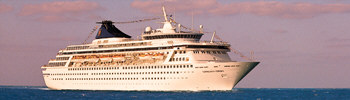
Our adventure to Terra Del Fuego and to Patagonia, which straddles both Argentina and Chile, and on to The Falkland Islands, or Malvenas as the Argentines call them began at Sea-Tac Airport, where all but 5 of our group assembled for our flight to Buenas Aires. Those 5, three of whom were from New York, and two from Scotland, joined us on the Buenas Aires waterfront where we boarded our ship, the Norwegian Crown. It was there that the real adventure began.
The Norwegian Crown
That evening we set sail for Montivideo, Uruguay, the birthplace of the Tango, and a grand old city very much like those of Europe 20 years ago. From there we cruised on rolling seas down to Porto Madryn, Argentina, a scenic Patagonian town first settled by the Welsh, but now a bustling area, thanks to agriculture and tourism. The port tour we selected was a three hour bus tour to a remote point of land named Punta Tombo, where we strolled through what may be the largest Magellan Penguin nesting colony in existence. You just can't be prepared for the thousands of them waddling busily all around you, coming and going to the sea and teaching their young the tricks of survival. It's hard to imagine such wild creatures being so tame; I caught one pulling on Lynn's pant leg, and another would have run off with my camera bag, if allowed. Another amazing animal we encountered in good numbers was the guanaco, a wild member of the camel family related to llamas. During a rest stop inroute we had a wonderful opportunity to photograph both species of swan native to South America, the Blackneck and the Coscaroba. After the return drive to Port Madryn we were treated to a narrated tour of the city, and still had about a half hour for shopping before we set sail for the Falklands.
Port Stanley is a quaint, very English looking frontier town on a barren, windswept island far out in the south Atlantic. The nearest land to the south is Antarctica. Its economy is based on sheep farming and fishing, but is bolstered by the presence of British troops, ever since the war with Argentina in the eightys.
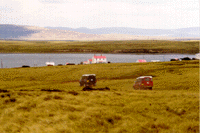
Not satisfied with the cruise ships tours at this stop, we had independently booked a cross-country jeep tour for us and 14 of our rugged companions, to see and photograph this marvelous country and its wildlife inhabitants. We were certainly not disappointed! In many places our four jeeps were not even on a dirt track as we headed cross-island. Our ultimate destination at the end of the three hours of bouncing was a point called volunteer point, to honor some natives who rescued stranded American mariners many years ago. Again we were totally unprepared for what we were about to see. Among the rolling hills and between a beautiful bay and the seacoast we stopped in the midst of thousands of Penguins, geese and sheep, all living peacefully together on the same land. It was an unbelievable photographic experience. In addition to the Magellan Penguins we had seen earlier, there were over a hundred magnificent King Penguins, each about 4 feet tall, with their young, and a large colony of Gentoo Penguins, many of whom had newly hatched chicks. The geese we noted at this location were of three species, Upland, Ashey-Headed and Ruddy-Headed Geese.
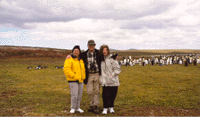
Sue, Paul & Lynn of Marysville Travel with King Penguins
On the return drive to Port Stanley the occupants of each jeep got to learn about life and war in such a isolated corner of the world from their drivers. It's a harsh life I can only equate to what it must have been like in this country during colonial times, except that now they have the advantage of communicating via sattelite phones and the internet.
From Port Stanley we headed directly for Cape Horn through choppy seas. A ceremony was held as we "rounded the horn", and we were each issued a certificate to that effect by the captain. It was a little erie to know that you were sailing above the bones of many a mariner who had'nt made it during those early sailing years, and of those who did, often it took a month or more to "round the horn".
From the horn we proceeded via the Beagle Channel to Ushuaia, a small Argentinian town at the southern end of Terra Del Fuego. Again at this port we had decided to deviate from the ship's tour itinerary and we booked our own wildlife tour via the internet. About half of our group belonged to The International Wild Waterfowl Association and were as anxious to see and photograph the many species in this area as we were. We were not dissapointed, Marcello was an excellent and well informed guide and seemed as interested in meeting us as we were in him. We saw a few species without even leaving town, and many more in the nearby national park. It turned out to be another successful and memorable day.
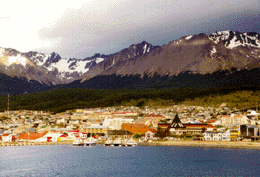
Ushuaia, Argentina
Between Ushuaia and Punta Arenas was a time of cruising through unbelievably beautiful scenery. Even if you've been lucky enough to have visited Glacier Bay Alaska, as we have, you will be awed by the unbelievable expanse of numerous glaciers and fjords, surrounded by total wilderness. It was unforgettable!
The next port of call was the city of Punta Arenas, a good-sized city that boasts of being the southernmost in the world. Through the ship we had booked a four hour trip to Otway Sound to see yet another Penguin colony. Although the 2 mile walk in strong winds was exhilarating and the place is well maintained, the penguins were a little sparse that day. We returned to town and spent the rest of the day walking around the city shopping and visiting the natural history museum.
Puerto Chacabuco provided a short stop ashore in a wet and windy part of Chilean Patagonia at one of the few places where the Andes touch the coastline. This port was recently constructed to supply the settlers in this isolated region. The scenery was marvelous.
At Puerto Montt we booked the longest of the ship's tours available, as this region is renowned for its beautiful lake district in the shadow of the magnificent Osorno volcano. Again we were not dissapointed. The cruise up Lake Esmeralda and the visit to Petrohue falls were exhilirating. We had a marvelous lunch at a Austrian restaurant on the shore of Lake Lianquiue, before a short shopping stop in the German-style town of Frutillar.
From Puerto Montt we cruised on the open South Pacific up the coast of Chile to Valparaiso, a major port city within driving distance of Santiago. From Valparaiso we were bussed to Santiago for our flights home. Enroute we drove through 3 mountain ranges and some beautiful fertile valleys where cropfield and vinyards abound. We enjoyed a stop for a buffet lunch at a winery/estancia where we were treated to Chilean wines. When we arrived in Santiago, situated at the foot of the Andes we were taken on a city tour that was very informative. That evening we caught our evening flight to Seattle via Miami.
In summation I'd have to say that this adventure ranks right up there with our African safaris and Polar Bear expeditions for excitement and breadth of experiences. It had the additional advantage of marvelous food, exquisite comfort and good entertainment, in addition to my personal favorite, a well stocked gym to help keep this old body from falling apart. I thoroughly enjoyed it from beginning to end. Try it - you'll like it.
|
|
|



